
From the Aperture blog Exposures.
I find this work really intriguing and inspiring, even if it isn't necessarily that innovative. The whole series can be seen online here.
Richard Ross: Photograph as Empty Stage and What's Next from Aperture Foundation on Vimeo.
"Opening in Washington D.C.’s National Building Museum this Saturday is Richard Ross’s exhibition, The Architecture of Authority. With this body of work, American photographer Richard Ross presents unsettling pictures of architectural spaces that each exert a kind of power over the individual. From a Montessori preschool to churches and mosques, to an interrogation room at Guantánamo and segregation cells at Abu Ghraib, Ross’s photographs reflect the state of our post 9/11 world—one in which he believes the public has become accustomed to the abuse of power, erosion of individual liberty, illegitimate authority, and constant surveillance.
In this video, Richard Ross highlights the physical relationship between the viewer and his images. Ross also gives insight into his new project, Suitable Placement: Juvenile Justice in America."
Showing posts with label Architecture. Show all posts
Showing posts with label Architecture. Show all posts
Saturday, April 18, 2009

Tuesday, March 10, 2009
DUNNE AND RABY
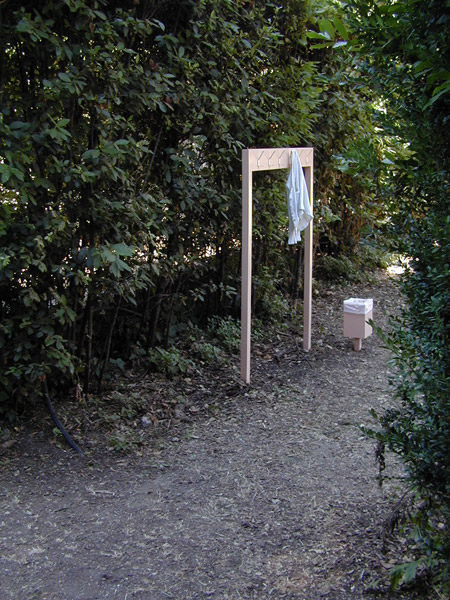
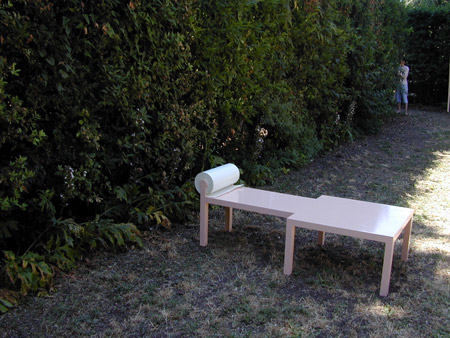
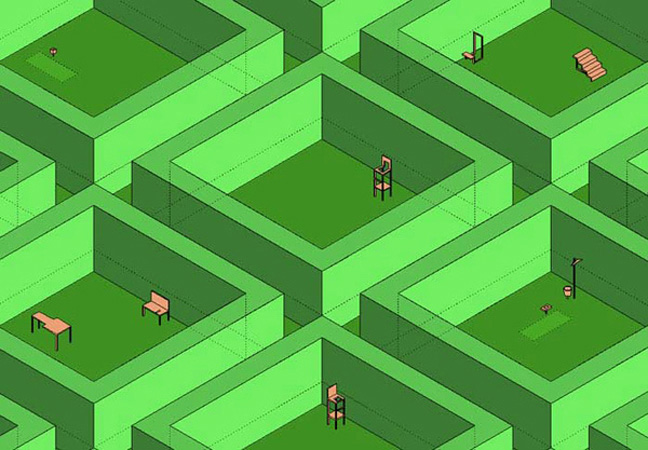
"A collection of adult furniture for the Medici Gardens in Rome.
The spaces in the gardens of the Villa Medici are like rooms, outdoor rooms without furniture. We would like to furnish them, and provide suggestions for how these neutral spaces could be used. Parks are strange places. During the day happy families play out idealised
scenarios of modern life, while at night, they become sites for a variety of illicit activities. Our furniture will make some of these night-time activities more convenient and at the same time, offer a critique of the kind of design that is always trying to make things nice, convenient, user-friendly, efficient and ergonomic (especially public furniture)." - Dunne & Raby
ALSO...
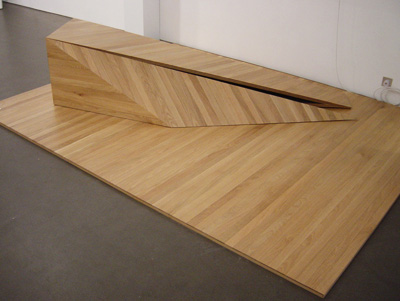
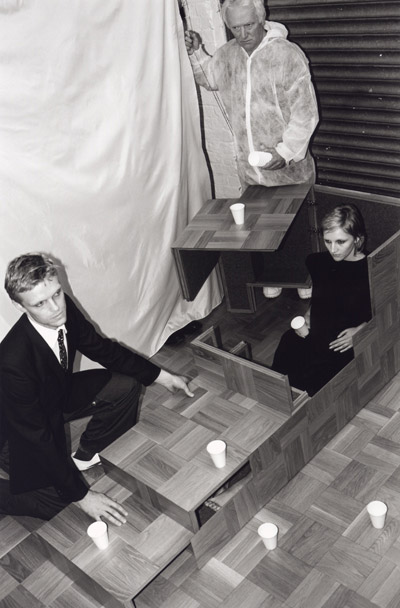
"Hideaway Furniture is part of the Designs for Fragile Personalities in Anxious Times series. There are three versions. They are designed to meet irrational but real needs, in this case, a fear of alien abduction."
AND...
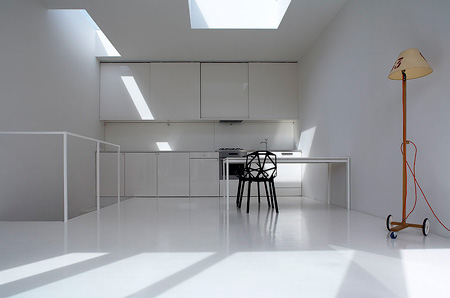
"A building project. A studio and a home. The architect and builder Cassion Castle worked very closely with us. The main requirement:'A place of calm'. It sits hidden behind the shops in Bethnal Green in a tiny street next to garages used by the market traders. Only one south facing facade can be manipulated freely."
AND...
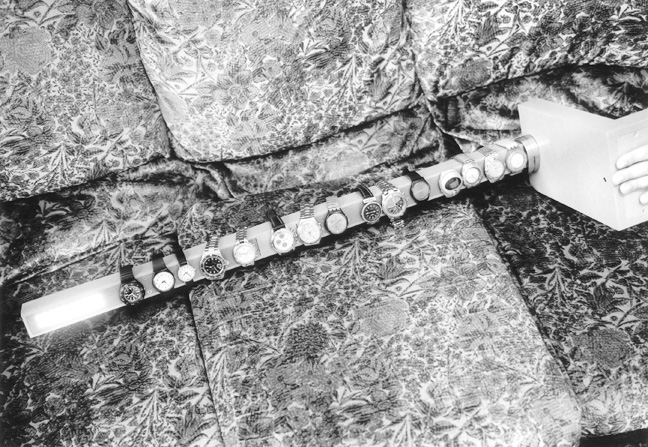
"Parasite light: A light that feeds off the leaky radiation of household electronic products; it only works when placed in electromagnetic fields."
They have so many cool things on their website. I highly recommend you explore their website dunneandraby.co.uk if you're into this stuff.
Saturday, February 7, 2009
OSLO OPERA HOUSE = SKATEPARK
 Photo: Jiri Havran via Wired
When I saw that Wired Magazine recently (Nov 08) did an article on the skate-ability of the new Oslo Opera House I got a little excited, stood up, and maybe...just maybe did a little dance. In High School I did too much skating and snow surfing to actually become an Architect, but I always knew that my board was helping me develop a very intimate relationship with our proverbial concrete jungle. My Senior year I won a Scholastic Gold Key for my photos of a skatepark that focused on the architectural merits of the shapes present and my post below about Mark Gonzalez is pretty specific about being hopeful for a more integrated public space and the interaction between skating and architecture.
"Snøhetta used different finishes of marble to guide skaters looking for rideable surfaces. Acoustically sensitive parts, like above the auditorium, got rough marble that's unpleasant to wheel over. But other areas silently beckon skaters. Surfaces rise up all over the place to become ledges, curbs, and benches—like the jagged facets of a glacier (or skate park). One particularly tempting spot is a 3-foot-wide railing of smooth stone. Snøhetta architect Peter Dang is, ahem, absolutely sure it's skatable. 'Just make sure to fall toward the inside,' he advises."
Another, even more informative and theoretically focused, article called "A Skateboarders Guide to Architecture, or an Architect's Guide to Skateboarding" can be found here.
This is an older video, but it's one of my favorites. Can't go wrong with Mark Gonzalez riding a skateboard anytime - much less a sorta longboard in an art museum dressed in a fencers uniform. ''I wanted to appear like a dancer but not too feminine,'' he said in a NYTimes article. ''The fencing uniform shows your body type but also means business.''
Though this is a music video for Jason Schwartzmans band Coconut Records (which has just released a new record called Davy, that I think is quite good) the footage is from Cheryl Dunn's film "Back World for Words" - which I would kill to see.
The next best thing however is this spectators vantage point that provides a little more connection with the performance.
I think this is a really groundbreaking 'piece' if it can be called that. I think architects, city planners, and curators could all benefit from thinking about this concept of the act of skateboarding (or other public sports that require equal parts cojones and finesse) as art. Not only the act, but the obstacle can hold more potential energy in their aesthetic than a Pollack. Bottom line: I'd love to see more integration of recreation into the cityscapes.
Though this is a music video for Jason Schwartzmans band Coconut Records (which has just released a new record called Davy, that I think is quite good) the footage is from Cheryl Dunn's film "Back World for Words" - which I would kill to see.
The next best thing however is this spectators vantage point that provides a little more connection with the performance.
I think this is a really groundbreaking 'piece' if it can be called that. I think architects, city planners, and curators could all benefit from thinking about this concept of the act of skateboarding (or other public sports that require equal parts cojones and finesse) as art. Not only the act, but the obstacle can hold more potential energy in their aesthetic than a Pollack. Bottom line: I'd love to see more integration of recreation into the cityscapes.
Subscribe to:
Posts (Atom)